Leaguers
Role
Product designer
Team
1 Tech Lead, 1 Designer
Timeline
Oct 2022 - May 2023
Skills
Product design, interface design, interaction design, prototyping, usability testing
Context
Leaguers connects college mentors with high schoolers for college essay support.
The platform moved away from using Google Docs to a built-in essay review system for secure, all-in-one collaboration.
Problem
The current interface feels outdated and unintuitive with cluttered layouts and inconsistent visuals.
Leaguers needs a new platform that has a modern interface that feels current, trustworthy and causes no friction.


Solution
Leaguers redesigns the essay feedback experience through inline comments, revision tracking, and collaborative mentor-student interactions.
The platform introduces clearer contextual feedback, streamlined revision comparison, and more conversational communication to make the editing process easier to navigate and less overwhelming.


User Interviews
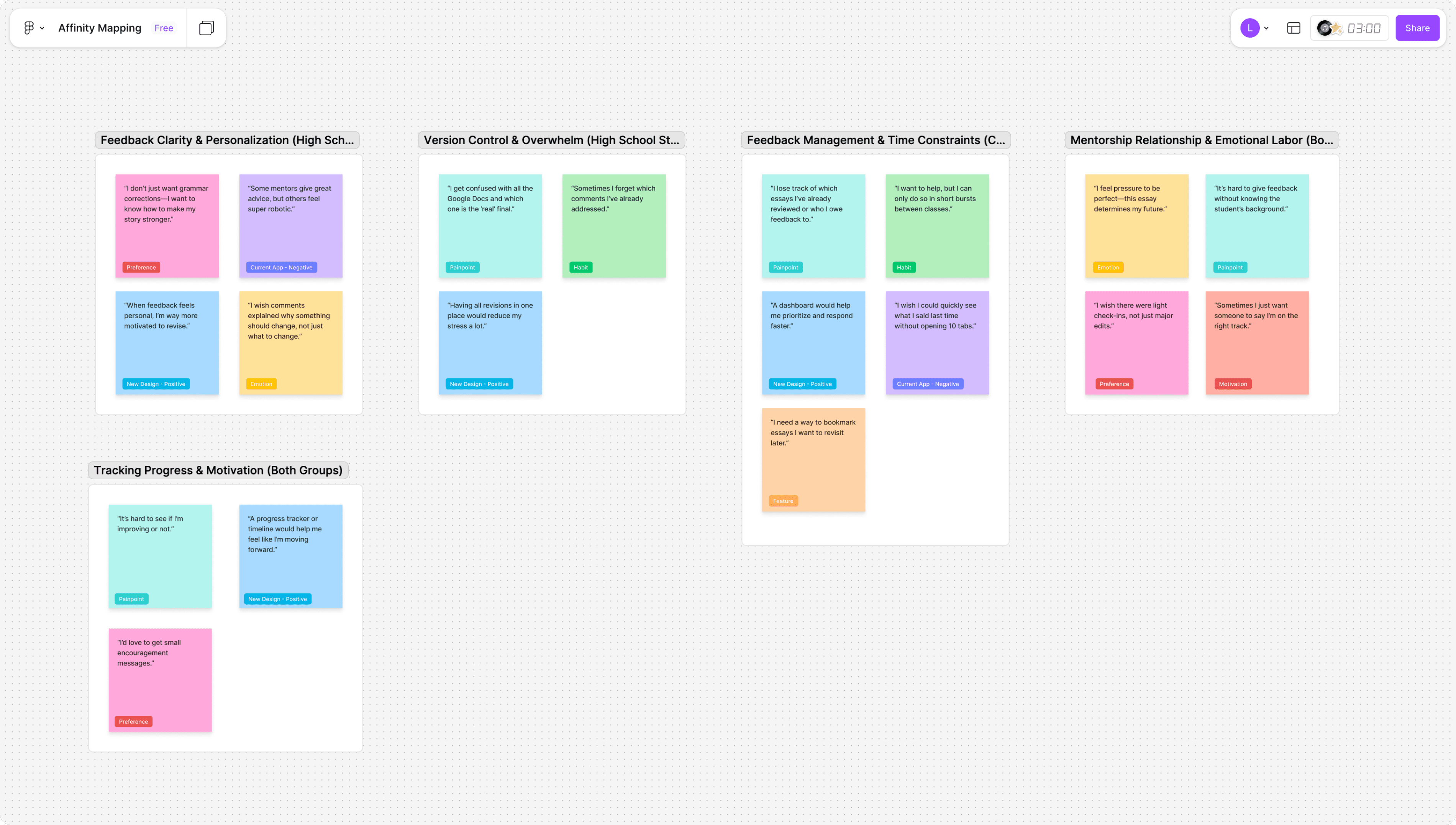
I conducted interviews with 10 participants, including existing users and individuals with experience with other similar platforms.
· 5 high school students: understand struggles with essay writing and managing feedback
· 5 college student mentors: identify workflow challenges and what makes delivering feedback difficult
Findings From Interview
High School Students
· Want clearer guidance on how to improve their essays beyond surface-level edits
· Feel overwhelmed by multiple versions and scattered feedback
College Mentors
· Struggle to manage multiple students and essays
· Find unstructured feedback hard to track
Both Groups
· Feel essay writing is deeply personal and emotionally taxing
· Need for a structured yet flexible system that supports clarity and progress tracking
User Persona
Based on interview findings, I developed personas for students and mentors to capture their different needs, behaviors, and expectations.


Design Statement
How might we make essay feedback easier to give, clearer to receive, and smoother to manage for both students and mentors?
Solution 1
In-Line Feedback Interface
We created a clean, modern interface that allows mentors to leave comments directly next to each essay paragraph. This structure mirrors the natural reading and feedback process, reducing context-switching.
Improve Feedback Flow
Mentors can now highlight and comment in-line, making their feedback more precise and easier to act on for students.
Clarify Intent
Grouped comments by type (grammar, structure, content, etc.) help students understand the purpose of each suggestion.
Process Overview
Before
The original interface felt dense and difficult to navigate. Hidden interactions, vague previews, and disconnected feedback made it hard for students to quickly understand comments.

Iteration
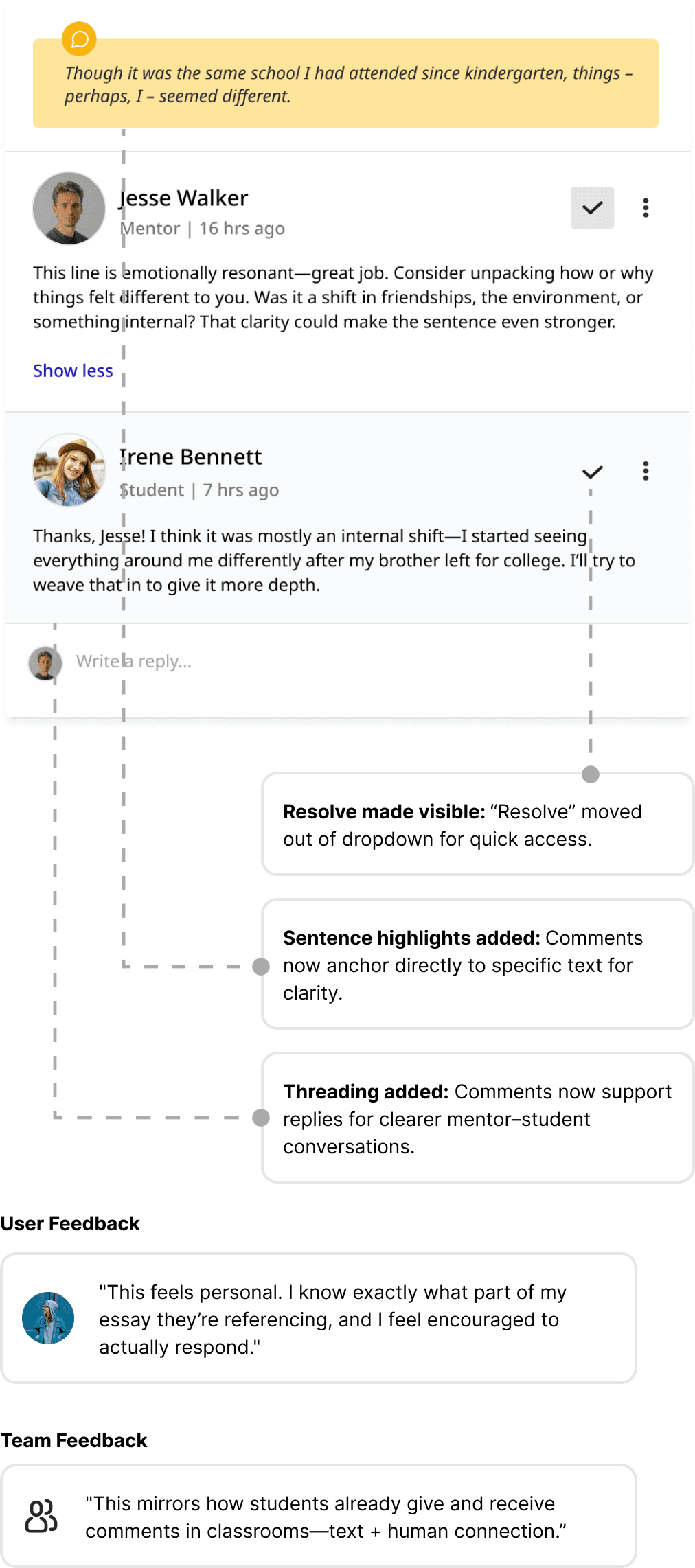
I improved visibility and scanability by introducing a cleaner card layout and showing full comments by default. However, users still struggled to identify which sentence feedback referred to, and interactions still felt one-sided.

After
The final design added sentence highlights and threaded replies to create clearer context and more natural mentor-student conversations. This made feedback easier to understand, navigate, and respond to.
Solution 2
Essay History & Feedback Timeline
The Essay History view enables both high school students and mentors to easily track the evolution of feedback over time.
Enhance understanding
See how essays have improved through revisions and feedback cycles
Improve mentorship
Help mentors tailor feedback based on a student’s past work and revision trends
Improve version clarity
Avoid confusion by clearly separating and labeling each essay draft.
Process Overview
Before (Interface Perspective)
The revision history interface relied heavily on text labels, forcing users to click into each version without enough context. This made navigation inefficient and increased cognitive load during essay revisions.

After (Interface Perspective)
The redesigned interface introduced side-by-side comparison and highlighted text changes, making revision tracking faster and easier to navigate.

Before (Flow Perspective)
Users had to repeatedly open different revisions to identify changes, creating a slow and disruptive review process. The lack of preview visibility made it difficult to quickly compare versions.

After (Flow Perspective)
Users could quickly identify changes through visual previews and revision tags, reducing the need to open multiple versions

Result & Impact
Redesigned essay feedback system served over 1,500 users and reduced mentor response time by 30%.
Team Feedback

Jason Yoon
Leaguers Tech Lead
“Lena brought the vision for Leaguers’ essay feedback system to life. Our original platform was difficult to scale and visually outdated, which made onboarding new users frustrating and time-consuming. Lena immediately understood the core pain points and reimagined the experience from both the student and mentor perspectives.
She consistently collaborated with engineering to ensure designs were implementable and logically structured. She clarified edge cases and proactively flagged usability concerns we hadn’t even considered.”
Reflection
Learnings
This was my first time designing an end-to-end essay feedback system, and it pushed me far beyond visual design into research, user interviews, usability testing, and cross-functional collaboration.
Bridging design and engineering
I made the mistake of handing off designs before syncing deeply with engineering. As a result, parts of the system had to be reworked for feasibility. I’ve since learned the value of bringing engineers into the design process early to spot constraints.
Balancing ideal and viable
There were many moments when I had to trade "perfect" for "possible." Whether it was adjusting the number of features at launch or simplifying complex flows, I learned how to prioritize what matters most for users.
Milestones

Received ₩50,000,000 in startup funding from the South Korean Ministry of SMEs and Startups.

Presented Leaguers to a panel of investors.

Leaguers operated out of a startup co-working hub in Seoul during product development.

Move-in day to our first office!