Ward

Role

Product designer

Team

1 Product Manager, 2 Developers, 1 Designer

Timeline

Jan 2026 - May 2026

Skills

Interaction Design, System Design, UX Research

Context

Ward is a conversational AI designed to support coordination between home care workers and family caregivers in high-stakes home care environments.

Problem

Home care coordination is fragmented across caregivers, making communication and continuity difficult.

User Interviews

Main goal was to understand how home care coordination currently works across shared caregiving environments.

Participants included home care workers and family caregivers who had varying levels of AI familiarity.

Findings From Interview

Relied on texting, verbal updates, handwritten notes, and memory

Information continuity broke down during shift handoffs

Managing appointments, reminders, and unfinished tasks created burden

Caregiving involved emotional labor beyond operational task management

Wanted AI that felt supportive rather than overly authoritative

Emphasized importance of preserving human judgment and trust

Solution

Ward became a home care coordination conversational AI that supports communication, task continuity, and collaborative decision-making.

It introduces summaries, shift handoffs, reminders, and low cognitive load interaction for shared caregiving environments.

User Interviews

Main goal was to understand how home care coordination currently works across shared caregiving environments.

Participants included home care workers and family caregivers who had varying levels of AI familiarity.

Findings From Interview

Relied on texting, verbal updates, handwritten notes, and memory

Information continuity broke down during shift handoffs

Managing appointments, reminders, and unfinished tasks created burden

Caregiving involved emotional labor beyond operational task management

Wanted AI that felt supportive rather than overly authoritative

Emphasized importance of preserving human judgment and trust

System & Interaction

System Design & Interaction Guidelines

Interaction behavior itself needed to be intentionally designed.

This created several challenges:

How should the AI speak to caregivers?

How much information should it provide at once?

How could it reduce stress rather than increase it?

I created an interaction guideline defining the AI’s conversational structure, behavior, tone, and error handling.

Design Principles

Acknowledge user input, use affirmative language, remain supportive rather than authoritative

Conversational Structure

Acknowledgement layer (confirm user input), action layer (explain what the system is doing), support layer (offer contextual follow-up support)

Designing for Low Cognitive Load

Create short responses, use calm tone, give progressive disclosure, lightweight conversational pacing

Information Architecture

Product was designed to support continuity across multiple caregivers through visibility, task coordination, reminders, appointment tracking, and escalation pathways.

System & Interaction

System Design & Interaction Guidelines

Interaction behavior itself needed to be intentionally designed.

This created several challenges:

How should the AI speak to caregivers?

How much information should it provide at once?

How could it reduce stress rather than increase it?

I created an interaction guideline defining the AI’s conversational structure, behavior, tone, and error handling.

Design Principles

Acknowledge user input, use affirmative language, remain supportive rather than authoritative

Conversational Structure

Acknowledgement layer (confirm user input), action layer (explain what the system is doing), support layer (offer contextual follow-up support)

Designing for Low Cognitive Load

Create short responses, use calm tone, give progressive disclosure, lightweight conversational pacing

Design

Initial Care Overview

When beginning a shift, caregivers could ask, “What’s the status of Ms. Rivera?”

The system responded with:

  • Current condition summaries

  • Previous caregiver notes

  • Emotional context

  • Suggested priorities


This was designed to help new caregivers quickly understand information like what happened previously.

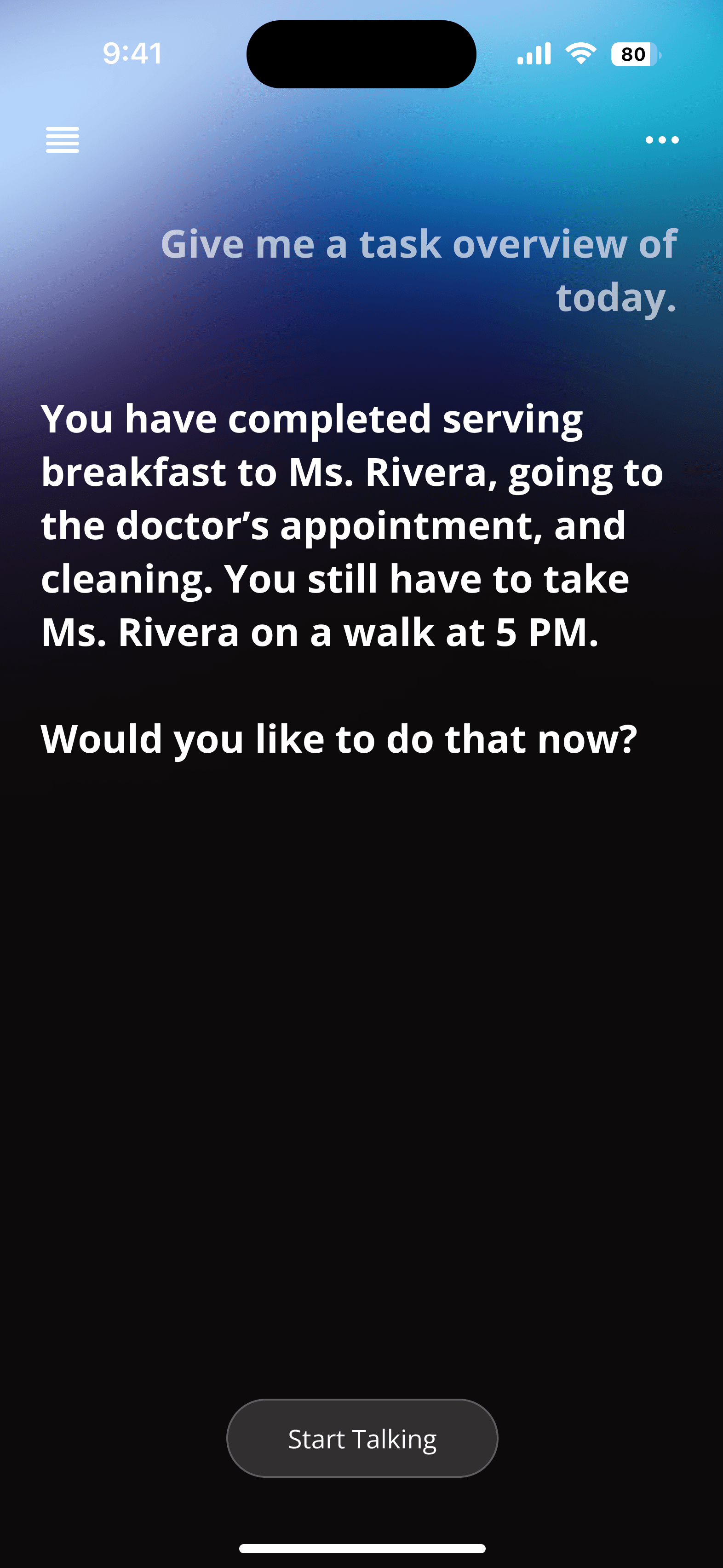
Daily Task Coordination

The system supported:

  • Meal coordination

  • Medication tracking

  • Appointment scheduling

  • Task progression


This was designed to guide caregivers through contextual conversational flows.

Notes & Shift Handoff

Caregivers could leave contextual notes for future caregivers.

  • Emotional observations

  • Behavioral patterns

  • Incomplete tasks

  • Care preferences

  • Follow-up reminders


This was designed to help preserve continuity between shifts and reduce information loss.

User Testing

Prototype Evaluation

Prototype was evaluated through moderated conversational walkthrough sessions where participants reviewed care summaries, logged tasks, left caregiver notes, reminders, and coordinated appointments.

Users Appreciated...

Immediate acknowledgements

Structured summaries

Reminder support

Users Wanted...

Shorter information summaries

Faster access to the important updates

More clarity of complete & incomplete tasks

User Testing

Prototype Evaluation

Prototype was evaluated through moderated conversational walkthrough sessions where participants reviewed care summaries, logged tasks, left caregiver notes, reminders, and coordinated appointments.

Users Appreciated...

Immediate acknowledgements

Structured summaries

Reminder support

Users Wanted...

Shorter information summaries

Faster access to the important updates

More clarity of complete & incomplete tasks

Iteration

Reducing Information Density

Before
Some responses and summaries felt too long during caregiving tasks.

After
The system introduced shorter conversational summaries and progressive information disclosure to reduce cognitive load.

Before

After

Prioritizing Important Updates

Before
Care summaries displayed all information with similar visual weight.


After
The system prioritized urgent or time-sensitive updates first to improve scanability during caregiving tasks.

Before

After

Improving Task Visibility

Before
Completed and incomplete tasks were visually grouped together, making task tracking harder during shift transitions.


After
The interface introduced clearer task status separation and visual hierarchy to improve continuity between caregivers. Also, incomplete tasks were notified through a reminder system.

Before

After

Result & Impact

The final prototype demonstrated how conversational AI could support care coordination through AI-mediated communication, task continuity, shift handoffs, reminders, and collaborative caregiving workflows.

Read Next ↓

Reflection

Learnings

This project shifted my perspective from designing screens to designing AI behavior and conversational systems in high-stakes human environments.

Designing AI behavior, not just interfaces

I learned that designing conversational AI requires thinking beyond visual interfaces and focusing on how systems communicate, guide decisions, handle ambiguity, and build trust through interaction.

Designing for human-centered AI collaboration

Working on Ward reinforced that AI systems in caregiving environments should support caregivers rather than replace human judgment. Small interaction decisions around tone, uncertainty, and conversational pacing directly influenced trust, emotional comfort, and cognitive load.

Read Next ↓